From Wikipedia, the free encyclopedia
Coordinates: 37.971421°N 23.726166°E
The
Acropolis of Athens or
Citadel of Athens is the best known
acropolis (Gr.
akros, akron,[1] edge, extremity +
polis, city, pl. acropoleis) in the world. Although there are many other acropoleis in
Greece, the significance of the Acropolis of Athens is such that it is commonly known as
The Acropolis without qualification. The Acropolis was formally proclaimed as the preeminent monument on the European Cultural Heritage list of monuments on 26 March 2007.
[2] The Acropolis is a flat-topped rock that rises 150 m (490 ft) above sea level in the city of
Athens, with a surface area of about 3
hectares. It was also known as
Cecropia, after the legendary
serpent-man,
Cecrops, the first Athenian king.
History
Early settlement
While the earliest artifacts date to the Middle
Neolithic era, there have been documented habitations in
Attica from the Early Neolithic (6th millennium BC). There is little doubt that a
Mycenaean megaron stood upon the hill during the late
Bronze Age.
[citation needed] Nothing of this
megaron survives except, probably, a single limestone column-base and pieces of several sandstone steps. Soon after the palace was constructed, a
Cyclopean massive circuit wall was built, 760 meters long, up to 10 meters high, and ranging from 3.5 to 6 meters thick. This wall would serve as the main defense for the acropolis until the 5th century.
[3] The wall consisted of two
parapets built with large stone blocks and cemented with an earth mortar called
emplekton (Greek: ἔμπλεκτον).
[4] The wall follows typical Mycenaean convention in that it followed the natural contour of the terrain and its gate was arranged obliquely, with a parapet and tower overhanging the incomers' right-hand side, thus facilitating defense. There were two lesser approaches up the hill on its north side, consisting of steep, narrow flights of steps cut in the rock.
Homer is assumed to refer to this fortification when he mentions the "strong-built House of
Erechtheus" (
Odyssey 7.81). At some point before the 13th century an earthquake caused a fissure near the northeastern edge of the acropolis. This fissure extended some thirty five meters to a bed of soft marl in which a well was dug.
[5] An elaborate set of stairs was built and the well was used as a protected source of drinking water during some portion of the Mycenaean period, as it was invaluable in times of siege.
The Dark Ages
There is no conclusive evidence for the existence of a Mycenean palace on top of the Athenian Acropolis. However, if there was such a palace, it seems to have been transplanted by later building activity on the Acropolis. Not much is known as to the architectural appearance of the Acropolis until the archaic era. In the 7th and the 6th centuries BC, the site was taken over by
Kylon during the failed Kylonian revolt, and twice by
Pisistratus: all attempts directed at seizing political power by
coups d' etat. Nevertheless, it seems that a nine-gate wall, the
Enneapylon, had been built around the biggest water spring, the "
Clepsydra", at the northwestern foot.
Archaic Acropolis
A temple sacred to "Athena Polias" (Protectress of the City) was quickly erected by mid-6th century BC. This
Doric limestone building, from which many relics survive, is referred to as the "Bluebeard" temple, named after the pedimental three-bodied man-serpent sculpture, whose beards were painted dark blue. Whether this temple replaced an older one, or a mere sacred precinct or altar, is not known. In the late 6th century BC yet another temple was built, usually referred to as the
Archaios Naos (Old Temple). This temple of Athena Polias was built upon the
Doerpfeld foundations.
[6] It is unknown where the "Bluebeard" temple was built. There are two popular theories (1) the "Bluebeard" temple was built upon the Doerpfeld foundations, (2) the "Bluebeard" temple was built where the Parthenon now stands.
[7] That being said it is unknown if the "Bluebeard" temple and the Archaios Naos coexisted.
To confuse matters, by the time the "Bluebeard" Temple had been dismantled, a newer and grander marble building, the "
Older Parthenon" (often called the "
Ur-Parthenon",
German for "Early Parthenon"), was started following the victory at
Marathon in 490 BC. To accommodate it, the south part of the summit was cleared of older remnants, made level by adding some 8,000 two-ton blocks of
Piraeus limestone, a foundation 11 m (36 ft) deep at some points, and the rest filled with earth kept in place by the retaining wall.
The Older Parthenon was still under construction when the Persians sacked the city in 480 BC. The building was burned and looted, along with the
Archaios Naos and practically everything else on the rock. After the Persian crisis had subsided, the Athenians incorporated many of the unfinished temple's architectural members (unfluted column drums, triglyphs, metopes, etc.) into the newly built northern
curtain wall of the Acropolis, where they serve as a prominent "war memorial" and can still be seen today. The devastated site was cleared of debris. Statuary, cult objects, religious offerings and unsalvageable architectural members were buried ceremoniously in several deeply dug pits on the hill, serving conveniently as a fill for the artificial plateau created around the classic Parthenon. This
"Persian debris" is the richest archaeological deposit excavated on the Acropolis.
The Periclean building program
Most of the major temples were rebuilt under the leadership of
Pericles during the
Golden Age of Athens (460–430 BC).
Phidias, a great Athenian sculptor, and
Ictinus and
Callicrates, two famous architects, were responsible for the reconstruction. During the 5th century BC, the Acropolis gained its final shape. After winning at
Eurymedon in 468 BC,
Cimon and
Themistocles ordered the reconstruction of southern and northern walls, and Pericles entrusted the building of the
Parthenon to Ictinus and Callicrates.
In 437 BC,
Mnesicles started building the
Propylaea, monumental gates with columns of
Pentelic marble, partly built upon the old propylaea of Pisistratus. These colonnades were almost finished in 432 BC and had two wings, the northern one serving as picture gallery. At the same time, south of the propylaea, building of the small Ionic
Temple of Athena Nike commenced. After an interruption caused by the
Peloponnesian War, the temple was finished in the time of
Nicias' peace, between 421 BC and 415 BC.
During the same period as the building of the
Erechtheum, a combination of sacred precincts including the temples of
Athena Polias,
Poseidon,
Erechtheus,
Cecrops,
Herse,
Pandrosos and
Aglauros, with its so-called the
Kore Porch (or
Caryatids' balcony), was begun.
Between the temple of Athena Nike and the Parthenon, there was the
temenos of
Artemis Brauronia or
Brauroneion, the goddess represented as a bear and worshipped in the
deme of Brauron. The archaic
xoanon of the
goddess and a statue made by
Praxiteles in the 4th century BC were both in the sanctuary.
Behind the Propylaea, Phidias' gigantic bronze statue of
Athena Promachos ("she who fights in the front line"), built between 450 BC and 448 BC, dominated. The base was 1.50 m (4 ft 11 in) high, while the total height of the statue was 9 m (30 ft). The goddess held a lance whose gilt tip could be seen as a reflection by crews on ships rounding Cape
Sounion, and a giant shield on the left side, decorated by
Mys with images of the fight between the
Centaurs and the
Lapiths. Other monuments that have left almost nothing visible to the present day are the
Chalkotheke, the
Pandroseion,
Pandion's sanctuary, Athena's altar, Zeus Polieus's sanctuary and, from Roman times, the circular temple of
Augustus and
Rome.
Hellenistic and Roman period
During the Hellenistic and Roman periods, many of the existing buildings in the area of the Acropolis were repaired, due to damage from age, and occasionally, war.
[8] Monuments to foreign kings were erected, notably those of the
Attalid kings of Pergamon Attalos II (in front of the NW corner of the Parthenon), and Eumenes II, in front of the Propylaia. These were rededicated during the early Roman Empire to Augustus (or perhaps Cladius), and
Agrippa, respectively.
[9] Eumenes was also responsible for constructing a
stoa on the South slope, not unlike that of
Attalos in the
Agora below.
During the
Julio-Claudian period, the Temple of Rome and Augustus, a small, round edifice, about 23 meters from the Parthenon, was to be the last significant ancient construction on the summit of the rock.
[10] Around the same time, on the North slope, in a cave next to the one dedicated to
Pan since the classical period, a sanctuary was founded where the
archons dedicated to
Apollo on taking office.
[11] In the following century, on the South slope, Herodes Atticus built his grand
odeon.
During the 3rd century, under threat from a
Herulian invasion, repairs were made to the Acropolis walls, and the "Beule Gate" was constructed to restrict entrance in front of the Propylaia, thus returning the Acropolis to use as a fortress.
[8]
Byzantine, Latin and Ottoman period
In the
Byzantine period, the Parthenon was turned into a church, dedicated to the
Virgin Mary. Under the Latin
Duchy of Athens, the Acropolis functioned as the city's administrative center, with the Parthenon as its cathedral, and the
Propylaia as part of the Ducal
Palace. A large tower was added, the "Frankopyrgos" (Tower of the Franks), demolished in the 19th century. After the Ottoman conquest, the Parthenon was used as the garrison headquarters of the Turkish army,
[12] and the
Erechtheum was turned into the
Governor's private
Harem. The buildings of the Acropolis suffered significant damage during the 1687 siege by the Venetians in the
Morean War. The Parthenon, which was being used as a gunpowder
magazine, was hit by
artillery fire and severely damaged. In subsequent years, the Acropolis was a site of bustling human activity with many Byzantine, Frankish, and Ottoman structures. The dominating feature during the Ottoman period was a mosque inside the Parthenon, complete with a minaret. Following the
Greek War of Independence, most post-Byzantine features were cleared from the site as part of a Hellenizing project that swept the new nation-state.

Acropolis of Athens at dawn, view from St. George Lycabettus Hotel
Archaeological remains
The entrance to the Acropolis was a monumental gateway called the
Propylaea. To the south of the entrance is the tiny
Temple of Athena Nike. A bronze statue of Athena, sculpted by
Phidias, originally stood at its centre. At the centre of the Acropolis is the
Parthenon or Temple of Athena Parthenos (Athena the Virgin). East of the entrance and north of the Parthenon is the temple known as the
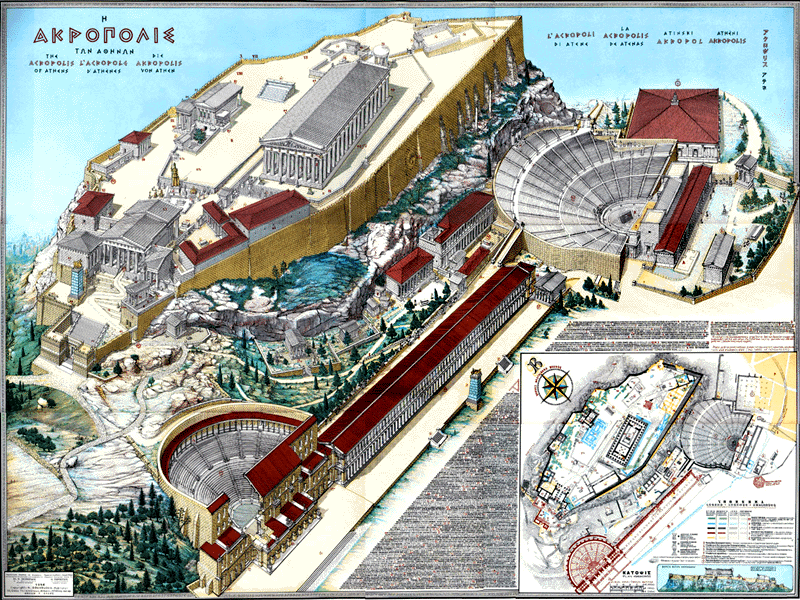
Erechtheum. South of the platform that forms the top of the Acropolis there are also the remains of an outdoor theatre called
Theatre of Dionysus. A few hundred metres away, there is the now partially reconstructed
Theatre of Herodes Atticus.
All the valuable ancient artifacts are situated in the
Acropolis Museum, which resides on the southern slope of the same rock, 280 metres from the Parthenon.
Site plan
Site plan of the Acropolis at Athens showing the major archaeological remains
- Parthenon
- Old Temple of Athena
- Erechtheum
- Statue of Athena Promachos
- Propylaea
- Temple of Athena Nike
- Eleusinion
- Sanctuary of Artemis Brauronia or Brauroneion
- Chalkotheke
- Pandroseion
- Arrephorion
- Altar of Athena
- Sanctuary of Zeus Polieus
- Sanctuary of Pandion
- Odeon of Herodes Atticus
- Stoa of Eumenes
- Sanctuary of Asclepius or Asclepieion
- Theatre of Dionysus Eleuthereus
- Odeon of Pericles
- Temenos of Dionysus Eleuthereus
- Aglaureion
The Acropolis Restoration Project
The Project began in 1975 and is now nearing completion. The aim of the restoration was to reverse the decay of centuries of attrition, pollution, destruction by acts of war, and misguided past restorations. The project included collection and identification of all stone fragments, even small ones, from the Acropolis and its slopes and the attempt was made to restore as much as possible using reassembled original material - with new marble from
Mount Penteli used sparingly. All restoration was made using
titanium dowels and is designed to be completely reversible, in case future experts decide to change things. A combination of cutting-edge modern technology and extensive research and reinvention of ancient techniques were used.
The Parthenon colonnades, largely destroyed by Venetian bombardment in the 17th century, were restored, with many wrongly assembled columns now properly placed. The roof and floor of the Propylaea were partly restored, with sections of the roof made of new marble and decorated with blue and gold inserts, as in the original. The temple of Athena Nike is the only edifice still unfinished, pending proper reassembly of its parts, all of which survive practically intact.
A total of 2,675 tons of architectural members were restored, with 686 stones reassembled from fragments of the originals, 905 patched with new marble, and 186 parts made entirely of new marble. A total of 530 cubic meters of new Pentelic marble were used.
Cultural significance
Every four years, the Athenians held a festival called the
Panathenaea that rivalled the
Olympic Games in popularity. During the festival, a procession moved through Athens up to the Acropolis and into the
Parthenon (Suggested to be depicted on the Parthenon frieze). There, a vast robe of woven wool (
peplos) was ceremoniously placed on Phidias' massive ivory and gold statue of
Athena.
References
- Notes
- ^ acro-. (n.d.). In Greek, Acropolis means "Highest City". The American Heritage Dictionary of the English Language, Fourth Edition. Retrieved September 29, 2008, from Dictionary.com website: Quote: "[From Greek akros, extreme; see ak- in Indo-European roots.] "
- ^ "Acropolis proclaimed top European Cultural Heritage Monument". News.xinhuanet.com. 2007-03-27. Retrieved 2010-12-23.
- ^ Hurwit 2000, p. 74-75.
- ^ ἔμπλεκτος, Henry George Liddell, Robert Scott, A Greek-English Lexicon, on Perseus Digital Library
- ^ Hurwit 2000, p. 78.
- ^ Hurwit 2000, p. 121.
- ^ Hurwit 2000, p. 111.
- ^ a b Travlos, John, Pictorial Dictionary of Ancient Athens, London: Thames and Hudson, 1971. p.54.
- ^ Hurwit 2000 p. 278
- ^ Hurwit 2000, p. 279.
- ^ Nulton, Peter, The Sanctuary of Apollo Hypoakraios and Imperial Athens, Archaeologia Transatlantica XXI, 2003.
- ^ Hellenistic ministry of culture History of the Acropolis of Athens
- Bibliography
External links